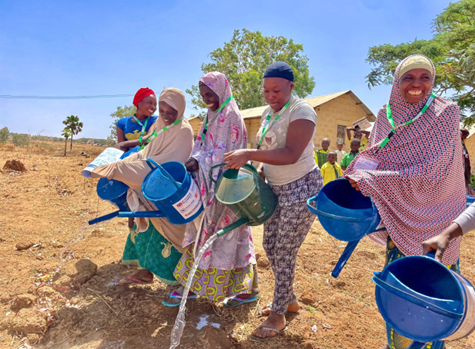
Nigeria SPRiNG works to reduce resource-related grievance and violence and to build climate resilience by supporting the adoption of sustainable NRM practices in agricultural and pastoral communities; strengthening land governance and use institutions by empowering civil society and community groups to advocate for equitable, accountable land governance while building the capacity of government and community institutions to deliver inclusive, gender‑ and climate‑sensitive land services; and reforming NRM and land governance frameworks by equipping regulatory bodies with the knowledge, skills and networks to design and implement inclusive, conflict‑sensitive policies—reducing exclusion, grievance and the likelihood that aggrieved groups resort to violence.
See below for further information on SPRiNG's focus areas.
Providing agricultural and pastoral communities with new information, knowledge, skills, inputs, tools and other vital resources required for the adoption of sustainable NRM practices in the contexts of conflicts, economic crisis and climate change, coupled with agricultural and pastoral communities collaboratively undertaking participatory land use mapping and increasingly adopting more sustainable NRM production systems will result in agricultural and pastoral communities adopting better conflict, economic and climate change related coping mechanisms and increasingly avoiding practices that exacerbate environmental degradation and natural resource depletion.
There will be increased resilience to climate change and more sustainable usage and management of natural resources, leading to reduced incentives for and incidents of violence.
By supporting civil society, community and advocacy groups to promote more equitable, responsive and accountable governmental and community based land governance and use institutions; and supporting governmental and community based land governance and use institutions with information, knowledge, skills and tools for more effective service delivery; and supporting governmental and community based land governance and use institutions to increasingly adopt innovative, efficient, gender and socially sensitive, and climate sensitive land governance policies and land use practices; there will be reduced incidents of land damage, grabbing and degradation.
This will result in improved land rights for local people and access to land for agricultural and pastoral communities. These improvements in land rights and access will fundamentally result in reduced incentives for using violence to address land related conflicts leading to reduced incidents of violence.
Supporting relevant government regulatory institutions with information, knowledge, skills and networks to recognise the value of reforming/initiating existing and new governance frameworks for Natural Resource and Land Management, and supporting relevant government regulatory institutions to increasingly reform/initiate governance frameworks that are inclusive, non-discriminatory, conflict-sensitive and fit-for-purpose, will result in reduced exclusion, discrimination and insensitivity around NRM and land governance frameworks.
There will be fewer grievances associated with exclusionary, discriminatory and insensitive frameworks, reducing incentives for aggrieved groups to resort to violence to address conflict linked to feelings of exclusion.
We know that change happens when we work together. Join our mailing list for updates on the latest SPRiNG research, initiatives and events.
Adding {{itemName}} to cart
Added {{itemName}} to cart